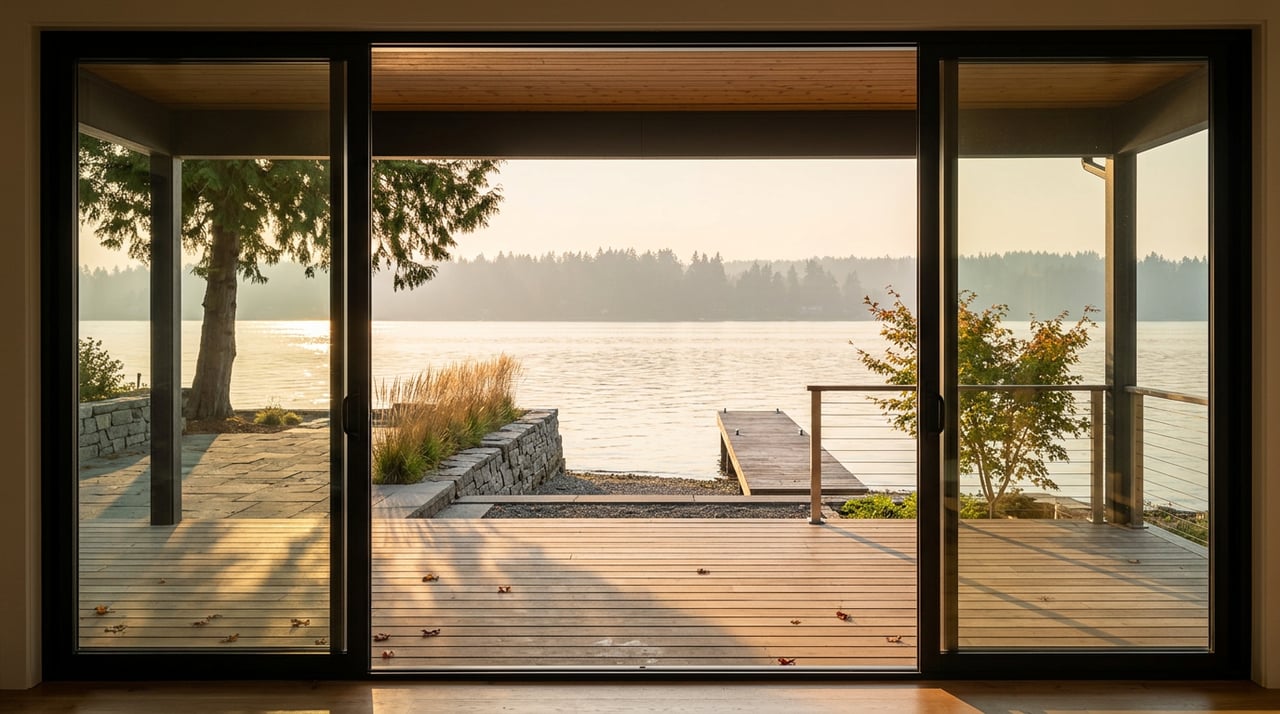
A buyer touring a shoreline listing on Coeur d'Alene Lake this summer assumed the existing dock was simply part of the house, the way a driveway or a fence is part of the house. It isn't. Docks on navigable water in Idaho are permitted structures, not fixtures, and the rules that govern them were rewritten by the 2026 Idaho Legislature and took effect on July 1. Anyone shopping the water right now is buying into a system that changed just over two months ago, whether their agent mentioned it or not.
That timing matters more than usual, because the price a buyer pays for that dock access isn't a modest step up from the neighborhood median. It's a different pricing curve entirely, and understanding why explains a lot about how Coeur d'Alene's various submarkets actually compare once you stop looking at the headline number.
The Permit Comes Before the Dock
Idaho treats the beds of its navigable lakes as public trust land, which means a private dock, marina, or shoreline stabilization project requires an encroachment permit from the Idaho Department of Lands before it can be built. Some private uses need a submerged land lease or easement on top of that. None of this is exotic in a lake state, but it does mean the dock a buyer sees at a showing has a paper trail somewhere, and that paper trail is worth requesting before closing rather than after.
The wrinkle specific to this lake: a stretch of Coeur d'Alene Lake's southern shoreline falls within the Coeur d'Alene Reservation boundary, and dock authorization there runs through the Coeur d'Alene Tribe's Shoreline Protection Program rather than state permitting alone. The Tribe extends dock privileges to waterfront owners and to secondary lot owners who belong to established homeowner associations, but the structure still has to be permitted through that program specifically. A buyer who assumes every dock on the lake answers to the same authority will be checking the wrong file.
Add the new 2026 rules on top of an existing dock and a buyer has three things to verify, not one: whether the current structure was ever properly permitted, whether it sits in a jurisdiction that requires Tribal authorization, and whether the rules that applied when it was built are the same rules that apply today. They may not be.
The Number the Median Hides
Here is why that paperwork carries more weight than it would in most housing markets. A per-square-foot look at Idaho's lake markets shows Coeur d'Alene Lake commanding a 104 percent premium for true lakefront over comparable homes just off the water, and Hayden Lake, the quieter market fifteen minutes north, running an even steeper 125 percent premium.
| Lake | Lakefront $/sq ft | Off-water $/sq ft | Premium |
|---|---|---|---|
| Coeur d'Alene Lake | $692 | $339 | 104% |
| Hayden Lake | $723 | $321 | 125% |
A gap that size means lakefront isn't a nicer version of the neighborhood around it. It's priced against an entirely separate pool of buyers competing for a fixed, non-expanding amount of shoreline, while the off-water homes a few blocks over price against the ordinary supply and demand of a growing Idaho city. That is exactly why the dock permit matters as much as it does. The premium isn't paying for square footage or finishes. It's paying for legal water access, and legal water access is the one part of the purchase that a change in state or tribal rule can alter after the sale closes.
What the City Median Is Actually Averaging
Coeur d'Alene's citywide numbers tell a calm story on their own. Closed-sale data covering the three months ending May 2026 put the city's median sale price at roughly $574,656, with homes selling in an average of 30 days, down from 35 days over the same period a year earlier. County-level listing data through June 2026 showed active inventory at 917 homes and a median listing price of $794,825, with days on market averaging 44.
Those numbers describe a market that has settled into something closer to balanced than the frantic bidding wars of a few years ago. But a single citywide median can't tell a buyer whether they're looking at a downtown condo, a Sanders Beach estate, or a Hayden Lake cabin, because those three products don't actually compete with each other for the same dollar.
Listings tracked in the neighborhood submarkets earlier this year sketch out where that median is actually pulling from. Sanders Beach and the homes ringing Tubbs Hill, a mix of historic estates and newer luxury construction with direct lake proximity to downtown, have priced in the neighborhood of $850,000 to $1.5 million. Hayden Lake's shoreline runs roughly $675,000 to $1.2 million. Fernan Lake Village, the smaller lake just east of downtown, offers a more attainable version of waterfront in the $550,000 to $750,000 range. Downtown condos built for lock-and-leave second-home use have clustered closer to $525,000. None of that is what the citywide median describes, and none of it moves the same direction the median moves.
The confusion compounds once you leave the lakefront entirely. A separate look at early 2026 listings pointed out that Hayden, the city, and Hayden Lake, the incorporated community on its shore, are genuinely different products that happen to share a name. Hayden's citywide median has been running in the $550,000s with inventory that tightened sharply and showings per listing climbing faster than anywhere else in the region, while Hayden Lake frontage prices against the same 125 percent premium curve as the rest of the lake market. A buyer searching one and meaning the other will pull up an entirely different set of homes.
Where the Value Actually Sits
If the lakefront premium is the headline, the Spokane River corridor through Post Falls is the footnote worth reading. River homes here often come with private docks and calmer water than the open lake, and because the river doesn't carry the same scarcity premium as true lake frontage, that access frequently prices at real value relative to the lake proper. Post Falls' median has run in the $520,000s in recent closed-sale reporting, and buyers who want a boat in the backyard without competing in the lakefront tier have historically found more room here than on Coeur d'Alene Lake itself.
That's not a knock on the lake. It's a reminder that water access and lake access aren't interchangeable terms, and the gap between them is exactly where a buyer's budget can stretch further without giving up the thing they actually came here for.
What This Means If You're Comparing Towns by the Median
The honest takeaway is that comparing Coeur d'Alene, Hayden, and Post Falls by their citywide medians answers a question most water-focused buyers aren't actually asking. The median tells you about the typical home in each city. It says almost nothing about the shoreline, because the shoreline trades on scarcity and permitting, not on the same supply curve as the subdivision three blocks inland.
Before comparing price tags across these markets, it's worth asking a more specific question: does this number describe frontage, or does it describe proximity? A $675,000 listing near Hayden Lake and a $675,000 listing in Hayden the city are not the same asset, and neither is a $600,000 home a block off Coeur d'Alene Lake compared to a $600,000 home with its own dock.
A Few Questions Worth Asking Directly
Does every lakefront listing in Coeur d'Alene include dock rights? No. Some waterfront parcels include private moorage, some share access through a community dock, and some have shoreline only, without permitted structures. Ask for the dock's permit history specifically, not just its presence in listing photos.
Is Coeur d'Alene Lake or Hayden Lake the stronger long-term value? It depends on what you're weighing. Hayden Lake carries the steeper per-square-foot premium and a quieter, more residential feel, while Coeur d'Alene Lake offers a livelier scene closer to downtown restaurants and the resort district. Neither is objectively cheaper once you're comparing true frontage to true frontage.
What actually changed on July 1, 2026? Updated navigable-waterway rules from the 2026 Idaho Legislature took effect that day, altering the state framework docks, piers, and shoreline structures operate under. Any purchase that involves an existing dock built under the prior framework is worth a fresh permit check rather than an assumption that old paperwork still applies.
Comparing lake towns by their medians will always miss the part of the story that actually determines what you're paying for. If you're weighing Coeur d'Alene against Hayden Lake, Fernan Lake Village, or the Post Falls stretch of the Spokane River, Chelsey Graves can walk you through which submarket actually matches your budget and your must-haves, dock rights included.